Author: David Preston

Brands, beer, rails, poems and puns

Marketing responsibly

“What do you do?”

Having spent virtually my whole career in marketing you would think that when asked this question I would have my answer down to a quick, well, honed response.  Instead, I used to say quite glibly “I make people buy things they don’t really need,” having learnt that trying to explain the ins and outs of what I do often results in polite vacant expressions and conversation soon moving on to another topic.

However, in today’s reality of the cost-of-living crisis coupled with climate breakdown my answer of old isn’t one that sits well with me, nor I imagine an ever-growing number of people, and neither should it. What, then, should be the answer to the real question of “What is marketing?” Or better “How do we do marketing responsibly?”

This isn’t about all brands having to have a “social purpose” – but about brand owners and retailers stepping up to ensure people can close the intention gap between wanting to buy sustainably and the reality of what they actually do or can afford.

As marketeers this is, something we’re adjusting to in the moment – still, here are 5 pointers to how we can be more responsible marketeers.

(1) Mean it. Really mean it. Most of us now agree with the science on human-accelerated climate breakdown and recognise the need to act, at pace and scale. But as a brand you’ve got to mean it. If you’re treating it as a tactic, or just sugar-coating a real lack of sustainable action, or if it’s just a way of sneaking out some new-news to attract some focus, then prepare to reap a poor harvest.

(2) Be honest and realistic about where you are and where you want to be. All companies and brands will be at different stages. Be honest about where you are today and confront the brutal truth about what it will take to change. You’re not alone. From talking to consumers in research two things stand out like sore thumbs.

Firstly, brands that are in catch-up and make a raft of sustainable claims without fully owning them get found out. Are they really substantiated? Are they what consumers want? Are they ownable and leverageable? Do they reinforce the positioning and associations consumers know of you? Rather than being an opportunity, it’ll be wasted effort.

Secondly, people want brands to do. You don’t have to solve the world’s problems in one go and no one is expecting you to. Tell people the journey you’re on, where you’re falling short and what you’re doing about it.

(3) Think of all your stakeholders. Ultimately, brands are created when your different stakeholder groups all know what you’re about. Your 30% plastic packaging reduction might shift the needle a touch, but the real win may be in corporate reputation, or a retailer being more willing to back you over someone who isn’t taking action. And this is important, because your immediate return on a sustainability investment may not add up in the short term – you’re going to have to evaluate it against your long-term brand and commercial goals.

(4) Keep it short, keep it simple, stand out. It’s always sobering, but vital, to remember how little people think about your brand, how little it actually means to them. Shopping is done in autopilot, the focus of attention is elsewhere and the world of sustainability – a complex and confusing soup of claims and strange terms, and sadly, hype – makes it even more difficult. Whatever you do needs to be easy to makes sense of, fast. It needs to be consistent against what consumers already know about you. Declutter your pack. Focus on what’s important. Shout it, don’t whisper it.

(5) It’s about ‘and…’ Again and again in research we’re hearing that people don’t want to have to compromise, be it on product quality, convenience, or their favourite brands unless they really have to. But this isn’t about fitting a round peg into a square hole – the ultimate act of marketing responsibly is to see that being sustainably offers us new ways to deliver what consumers want, but better and with fewer negative impacts…. if we’re willing to embrace the challenge to get there.

The Crow Flies are presenting at the Soil Association Organic Trade Conference on 19th October, including on themes of greenwashing and marketing sustainable products during the cost-of-living crisis. If your brand is facing these challenges, do get in touch.

Gael Laurie is Brand Building Director of The Crow Flies, a research, strategy and innovation company that helps brands find a direct route to long lasting success.  gael@thecrowflies.co.uk; +44 (0) 1889 725670; www.thecrowflies.co.uk; @crowflieshigh. © The Crow Flies, 2022

Caw! It’s the Crow Chronicle, Autumn 2022

As if by magic, the leaves are turning brown, the last flowers are blooming, and brand builders start thinking about the run into Christmas. Well, here’s some light reading, the latest Crow Chronicle in which we *cough, cough* humbly show off about some recent successes we’ve been part of helping to get to market. And, we talk about some of the considerations to be thinking about during these ‘interesting times’ we’re living in.

Make a lovely warming Twig Broth, pop some Worm Bites in the oven and put your feet up to enjoy the latest… Crow Chronicle AUTUMN 2022.

The Market Map

Helping our partners develop strong foundations for their brand building is why us Crows do what we do. And it’s a bonus when we hear feedback like this. If you want to know more about our Market Map and how it can help you understand your brand and its future, give Crow a call on +44 (0) 1283 295 100 or caw@thecrowflies.co.uk.

#brandbuilding #MarketMap #positioning #alignment

The Perils of Penny The Pen Portrait

Bringing to life your target consumer or customer in a way that’s useful and meaningful to your marketing efforts, whilst also acting as an empowering guide in the business is a big question. It’s one we face a lot on many projects from research, positioning and often business strategy too.

It’s an really important question too. Bringing to life consumer segments effectively can focus the business and aid execution and commercial delivery. But too often we reach for the ‘Pen Portrait’ solution – you know, ‘Penny’ or ‘Ethan’, ‘Sanjit’ or ‘Olivia’.

The principles of targeting are well established (if debated and not always agreed with) but whatever your view on it, it’s always a big mistake to confuse ‘targeting’ with ‘micro-targeting’ which is what frequently happens. Targeting can be empowering, but micro-targeting can give the perception of being focused whilst actually restricting your commercial potential. So it’s important to tread carefully…. we see five traps that can catch the unwary marketeer:

  • Too personalised or over specified. This is trap we most often see. By making something very individual (‘This is Dan, he’s 28, lives an apartment in Greenwich with his partner…’) the receiver’s decoding of the targeting becomes personal (He’s not like any Dan I know) and may have the opposite to intended effect – making it unrelatable. The idea of the Pen Portraits here is find a central representation of the target group, but in making it too personal the opposite happens and the target narrows and becomes too singular – when you go out looking for the target you can’t find them.
  • Too broad. Breadth is, counter-intuitively, important in targeting. You want to find a meaningful commercial prize to aim at after all. But too broad becomes useless. Millennials anyone? Yes, that’s right! Let’s assume every one of the 14 million “millennials” in the UK share the same attitudes, characteristics and behaviours. It’s lazy and worse, largely useless in helping a brand.
  • Too stereotyped which may have initial appeal inside the business, but when you actually try and recruit, you find it’s hard to find your targets. The hidden biases inherent in identifying may have some very broad-brush recognition from the audience but in the detail they’re not there – in reality, people just don’t fit the mould.
  • Too unrelatable – a big challenge when you have a business that isn’t particularly customer or consumer orientated. Leadership can often feel that they represent the customer. You need a strong argument and commercial case to dislodge these deep set opinions. And some bravery too – hence, teams often roll with it a bit or don’t nip the problem in the bud at source.

There isn’t a perfect answer but equally, there’s no doubt that building up a set of target audience typologies is useful for helping the business (and decision makers in particular) be clear on who we’re going after, who we’re not, and why. But what’s important in the Pen Portrait is likely to vary by category and you may need different elements depending on your category or brand situation. For example, although broad, life stage may be discriminating for you. Or, perhaps, you want to target everyone but only on specific occasions or moments.

We’ve bags of experience working out through research who to target and how to best bring them to life and set them to productive work in a business. If we can help you with your targeting, drop us a line.


David Preston is founder of The Crow Flies, a research, strategy and innovation company that helps brands find a direct route to long lasting success.  david@thecrowflies.co.uk; +44 (0) 1889 725670; www.thecrowflies.co.uk; @crowflieshigh. © The Crow Flies, 2022

Natural & Organic Products Europe, 4th April 2022

Crow Gael is flying from the Nest to present and be part of a panel at this year’s Natural & Organic Products Europe. It’s down in the Smoke at the ExCel on 4th April.

She’ll be talking about “A Changing Attitude towards Food, Sustainability and Organic” – informed by our research on behalf of the lovely bunch at the Soil Association. So, if you need a nice and natural day out and promise not to heckle, we’ll see you there Crow Friends! Bring your own worms.

Link to register & join: https://lnkd.in/e7B-c4As

New Crow Line Number

TELEPHONIC CROW NEWS!

The Crow line number is changing from TODAY… for the three Crow Friends who use it, please update your contact records to…. *drum roll*….

01889 725670.

And again, that’s… 01889 725670.

If you’re outside the United Kingdom it’s +44 (0) 1889 725670.

For Corvids,  Raven, Chough, Jackdaw, Magpie and such like, it’s 01889 725670.

All Tits, Starlings, Noisy Gulls, Wading Birds, Cormorants and Flamingo, please dial 01889 725670.

For Squirrels, Pine Martens, Water Vole and Badgers, please use 01889 725670.

If you’re a Big 5 Game Species, dial call 01889 725670 and try not to eat anyone in the process please.

Mobile phone numbers, e-mails, snail mails, social media messaging, WormsApp, Twigter and Carrier Pigeons are all unaffected by this change.

Thanks you lovely lot!

Crow

Brand Planning: the bridge from strategy to action

If you’re a marketeer in one of the many businesses, who, courtesy of HMRC, are approaching your year end at the end of March, you’re now thinking about brand planning. Brand planning is a vital building block of all business as well as marketing, but it is often treated as something that ‘just happens’, for which common sense alone is good enough to do an adequate job, and gets steered by finance or strategy.

Unless marketeers apply greater rigour and ownership to the discipline of planning, we will limit our ability to deliver the primary aim of brand building companies, to positive impact target customers to effect successful change. And if we can’t do this, we won’t be taken seriously by others in the business.

As it is, sadly, most brand plans don’t get implemented. Why?

Confusing tactics with strategy. Getting excited by and jumping straight to the things you want to do. “Strategy” is an amplifying word, added to other terms to give them a sense of greater importance. Planning embraces three phases, each with a specific goal, sequentially linked and each distinct.

  1. Diagnosis: understanding the situation the brand (or company) is in, and why.
  2. Decide: working out how do we deal with the situation we face. Where do we want to be? What are the options for getting there cognisant of our competitive situation? This is the strategy.
  3. Do: the plans or tactics. Working out what the few, high impact, activities are that we need to execute in order to achieve our strategy. Being clear on what the distractions are.

Getting the diagnosis wrong based on the situational analysis, likely caused by data gaps, overbearing opinions or underplaying owned strengths of the brand or a competitor

Derailed process due to misalignment. Mid-way through the process an intervention from a senior leader questions the work so far, losing momentum and bursting the precious bubble of confidence that had been created.

Choosing the wrong competitive strategy e.g. not leveraging a real strength or perhaps taking on a competitor in the wrong way.

Failing to unite, align or enthuse key stakeholders involved in signing off or implementing.

In response to these issues, we have developed ‘Hourglass’ brand planning, reflecting the shape of the process planning needs to follow. Starting broad, narrow at the centre when focusing on the needs of the customer and the business and then flowing out again to the actions.

Hourglass planning is built off a small number of critical foundations, themselves rooted in the insight that cause planning to trip up:

  • Start by going broad in analysis; not just in terms of the content and approach to gathering data and making sense of it, but also in listening to the perspectives, opinions or strongly held views of key stakeholders in the process.
  • Make sense and choose what’s important. There are lots of tools available to aid with situational analysis but what’s missed is the human act of sensemaking and choice. You don’t want to end up with a very comprehensive but utterly useless synthesis of the current state. It’s what you choose to pull out and take action on that’s important. You’re looking for company or brand strengths that are distinctive, defensible, ownable, leverageable or competitor weakness that are the same. Boil it all down. Focus on the few enablers and blockers of growth because these will be at the heart of your action plan.
  • Be clear on who you’re competing for and evaluate and test everything through their lens.
  • Ensure you have long term foundations in place. Purpose, mission, vision are not interchangeable. You need to know the role of each and how it helps you make clear decisions that more often than not, are right.
  • small number of action platforms that flow directly out of the diagnosis. If you can’t see the insight threads from the diagnosis at the top of the process to the actions at the end, then your plan is likely misdirected and you’ll struggle to get buy in and engagement.
  • Brand activities that deliver against the essentials: we have yet to see an effective brand plan that does not deal with three themes: the brand’s ‘mental availability’, its ‘physical availability’ and bridge between the two, trial & repeat. The 4P’s fit here.
  • Great brand plans sacrifice. Don’t confuse this with prioritisation. Too often, prioritisation is a pretence that some things are more important but, through sleight of hand, we can still do everything. You can’t. Kill stuff properly and just focus on what’s really important.

Our experience in brand planning is built from both client side and agency experience. If we can help you with your planning challenge, get in touch.

David Preston is founder of The Crow Flies, a research, strategy and innovation company that helps brands find a direct route to long lasting success.  david@thecrowflies.co.uk; +44 (0) 1889 725670; www.thecrowflies.co.uk; @crowflieshigh. © The Crow Flies, 2022

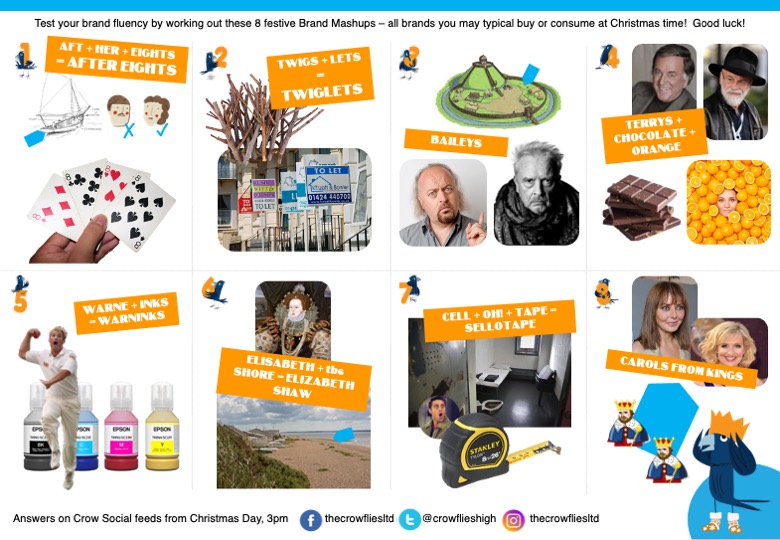
Mashup Time!

Yes, Crow Friends, yes, yes YES! It’s Christmas Brand Mashup time – and we’ve got EIGHT wonderfully festive brand mashups for you to get your beaks into. Every one is synonymous with Christmas, just say what you see and mmmmmash them together…

HIT THE LINK TO MASH AWAY… Crow Christmas Mashups

Answers posted on Christmas Day at 3pm here and on our socials:

FB @thecrowfliesltd
Insta @thecrowfliesltd
Twit @crowflieshigh

Enjoy and Get Mashing!

Christmas Chronicle

A few more days and it’ll be a new year – another cycle of life and naturally, of brand planning too! Here’s our latest Christmas edition of the Crow Chronicle with a focus on brand planning. Too often it’s left to common sense and the ebb-and-flow of the business planning cycle (led by finance? Or strategy?). No more! As a brand guardian it’s time to grab control and be prepared to sacrifice! Onwards!!

Crow Chronicle Christmas